

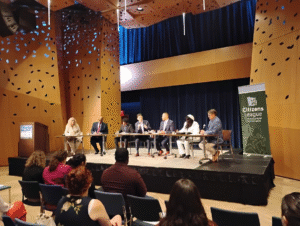
The top four Minneapolis mayoral challengers squared off against Mayor Jacob Frey in a Heated Debate.
(photo/Clint Combs MSR)
BY CLINT COMBS
In a sharp and often personal mayoral debate on Friday, Sept. 26, Minneapolis Mayor Jacob Frey and State Senator Omar Fateh clashed over ethics, housing policy, policing, and leadership style. Held at Westminster Presbyterian Church, the debate was the most heated to date in what has become one of the most ideologically charged races in recent Minneapolis history.
The forum ended with a question about a past ethics controversy involving Fateh’s wife, following reports that she could have benefited from legislation he supported but never passed. Fateh categorically rejected the allegation:
“Absolutely, that was a false story. We connected with every single media outlet that reached out, provided them with the facts—that my wife started a business in 2021 that never operated, that never functioned.”
He characterized past ethics complaints—many related to absentee ballots and campaign activities involving his associates—as politically motivated and partisan:
“Every single ethics issue that you’re mentioning came from Republican-led efforts. That campaign originated from a Project Veritas video—that was a right-wing attack about ballot harvesting and voter fraud… We addressed that in the Ethics Committee.”
Mayor Frey also faced questions about ethics, specifically regarding Abdi Nur Salah, a former advisor with ties to the Feeding Our Future scandal:
“The minute we found out about that staffer, he was fired,” Frey said. “I can’t speak beyond that.”
Frey tried to highlight a moment when he defended Fateh against far-right attacks, referencing vandalism at Fateh’s office:
“Immediately after you had been attacked—whether by Charlie Kirk or just recently—I called to offer every bit of assistance from the Minneapolis Police Department and beyond.”
Fateh responded bluntly:
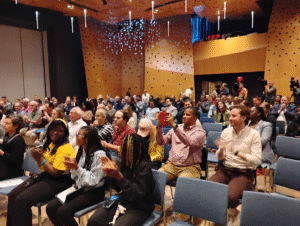
Voters at Westminster Hall cheering at the end of an
intense debate (photo/Clint Combs MSR)
“What the mayor just said is false. We reached out to MPD and the chief after our office was vandalized, but it took nearly five hours for them to respond. That’s when I got a call from the mayor.”
Policy disagreements were stark, especially on housing.
Fateh was the only candidate to fully support rent control. He also supports a commercial vacancy tax.
“In 2021, voters overwhelmingly supported exploring rent control,” said Fateh. “We can learn from St. Paul about exemptions that incentivize good behavior—affordable units, compliance. In this moment, when renters are squeezed and inflation hits, we must protect all renters.”
On homelessness, Fateh proposed shifting oversight from the Minnesota Department of Human Services (DHS) to the Minnesota Department of Health Services (MDH), framing homelessness more as a public health issue. Rev. DeWayne Davis supports keeping the services at DHS, with more staff.
At a mayoral forum in June 2025, all of Frey’s challengers—Fateh, DeWayne Davis, Brenda Short, and Jazz Hampton—expressed support for disciplining Police Chief Brian O’Hara. O’Hara reassigned Sergeant Mark Hanneman from leading MPD’s use-of-force training due to his involvement in the fatal shooting of Amir Locke. This may explain why, except for Short, the challengers seem more open to working with O’Hara.
“I think it would be irresponsible for me to make that decision before the election,” Fateh said. “I’ve had strong disagreements with the police chief, but I need to meet with him and the City Council to come to a conclusion.”
Frey, who appointed O’Hara in 2022, continues to defend his chief amid internal dissent and community criticism.
Jamal Osman served as the swing vote authorizing a lawsuit against landlord Hamoudi Sabri over a homeless encampment, with Council Members Robin Wonsley, Jeremiah Ellison, and Katie Cashman absent.
“I’ve dealt with many encampments,” Osman said. “We are not holding the same standards on all city-owned land.”
Osman cited examples where the administration refused to provide Camp Nenookaas porta-potties despite requests, calling the enforcement selective.
Fateh, however, was more direct in his criticism:
“He lied about banning no-knock warrants ever since Amir Locke died. He lied about there only being 27 unhoused neighbors—that wasn’t true. He lied about ending homelessness within five years, and now there are more unhoused neighbors than when he took office. He lied about standing with Uber and Lyft drivers, then vetoed their bill. He lied about supporting labor and unions, then vetoed the Labor Standards Board. And he lied—again and again—about standing up to Donald Trump while letting MPD collaborate with ICE.”